Joy Chen
0
joyychen@stanford.edu
Graduate Student - Economics
SCPKU Pre-Doctoral Fellow, September - December 2016

A center of the Freeman Spogli Institute for International Studies
 FSI researchers consider international development from a variety of angles. They analyze ideas such as how public action and good governance are cornerstones of economic prosperity in Mexico and how investments in high school education will improve China’s economy.
They are looking at novel technological interventions to improve rural livelihoods, like the development implications of solar power-generated crop growing in Northern Benin.
FSI academics also assess which political processes yield better access to public services, particularly in developing countries. With a focus on health care, researchers have studied the political incentives to embrace UNICEF’s child survival efforts and how a well-run anti-alcohol policy in Russia affected mortality rates.
FSI’s work on international development also includes training the next generation of leaders through pre- and post-doctoral fellowships as well as the Draper Hills Summer Fellows Program.
A new course jointly taught by Stanford and Peking University brought together students and scholars in China and the United States in dialogue using videoconferencing.
Each week during the past spring quarter, students at Stanford and Peking University (PKU) gathered in a classroom to learn, just as they would for any other course. The only difference was these students were neither in the same classroom nor on the same continent.
Despite being separated by nearly 6,000 miles, 18 students in Palo Alto and 28 students in Beijing held ‘face-to-face’ conversations via high definition videoconference in a course taught by American and Chinese scholars. On each side, they sat in a three-rowed amphitheater and looked directly ahead – not at a whiteboard – but at a screen that projects a video ‘wall’ of their colleagues at the other campus. The venue, known as a ‘Highly Immersive Classroom,’ enabled the distance learning experience between the two universities, using advanced software to create a cross-Pacific virtual classroom. The course titled The United States, China, & Global Security, led by former U.S. Ambassador to Afghanistan Karl Eikenberry and PKU professor Fan Shiming, was organized under the auspices of the U.S.-Asia Security Initiative whose research focuses on security challenges in Asia with teaching as one of its core activities.
“We set out to host a course that addressed topics critical to China and the United States in a new type of classroom format,” said Eikenberry, the Oksenberg-Rohlen Distinguished Fellow in the Shorenstein Asia-Pacific Research Center and director of the Initiative. “What resulted was a truly unique academic exchange that considered topics even beyond the bilateral relationship and carried a certain ‘Silicon Valley spirit’ being divided by an ocean yet connected through technology.”
“I loved the cybersecurity class because there was a lot of candor on both sides.” -Shan Jee Chua, PKU graduate student |
Over eight weeks, a select group of graduate students from the two universities explored a wide array of subjects related to international security, ranging from terrorism to trade and energy and the environment. The course aimed to provide students with a forum to discuss current issues in U.S.-China relations and to analyze areas that could be applied to other case studies.
“Because each week was a different topic, it didn’t feel like I was just thinking about the United States and China again every Wednesday night,” said Sam Ide, a Stanford graduate student who studies China’s relations with Central Asia. “Each session was very interesting to me in a different way.”
Guest-taught by prominent scholars and former senior government officials from the United States and China, the course sessions allocated thirty minutes for each lecturer to present, followed by a thirty minute question-and-answer period in which students were given the opportunity to interact with the lecturers and their peers on the other campus. Lecturers from Stanford included nuclear scientist Siegfried Hecker, former U.S. Secretary of Energy Steven Chu, and Thomas Fingar, a former deputy director at the U.S. Office of the Director of National Intelligence; and from PKU, Dean of the School of International Studies Jia Qingguo, and arms control and disarmament expert Han Hua. All discussions were off-the-record to encourage candid exchange of ideas.
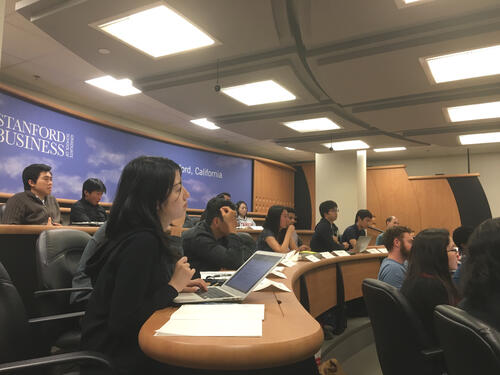
At Stanford's Highly Immersive Classroom in Palo Alto, students look ahead at their counterparts in Beijing.
One course session in particular resonated with students. The session, taught by Zha Daojiong, a professor of political economy at PKU and Herbert Lin, a senior research scholar at Stanford’s Freeman Spogli Institute for International Studies, focused on the changing nature and future of cybersecurity relations between China and the United States.
“I loved the cybersecurity class because there was a lot of candor on both sides,” PKU student Shan Jee Chua recalled.
Kimberly Chang, a second year Stanford graduate student in management science and engineering, noted that it was beneficial to hear the Chinese view on cyber “because most of the talk within the United States has been from an American perspective.”
“Hopefully, I'll be able to meet some of these people in real life who I've met on the 'wall.'” -Sam Ide, Stanford graduate student |
The course revealed a broader range of perspectives and provided a chance to interact first-hand with international colleagues while remaining at their home campus. Discussion amongst peers uncovered the “behind the scenes stories” and added context to media reports found online or in print, said Seung Kim, a student in Stanford’s East Asian studies program.
Besides the technology, a unique aspect of the course was its diversity. More than half of the course participants were international, representing 15 countries beyond China and the United States. That setting encouraged debate and reinforced the notion that “neither the United States nor China is the center of the universe,” said Zhu Jun Zhao, a PKU international relations student.
When students were asked what could bring about better understanding between China and the United States, continued dialogue was a common answer. The future of U.S.-China relations rests in the hands of people talking to one another: “I think we need more honest conversations,” Chang said.
And for some students, an opportunity to hold those conversations in-person may be close. Ide said he anticipates traveling to Beijing over the summer and plans to try and meet with a few of his counterparts whom he met through the course.
“Hopefully, I’ll be able to meet some of these people in real life who I’ve met on the ‘wall.’”
Related Links:
Video showcases SCPKU's Highly Immersive Classroom enabling co-teaching across the Pacific

The Hoover Institution on War, Revolution, and Peace was founded nearly 100 years ago as the Hoover War Library with a donation by Herbert Hoover, who later said, “This Institution is not, and must not be, a mere library, but…must dynamically point the road to peace, to personal freedom, and to the safeguards of the American system.” Since its founding, the Hoover Institution has grown into one of the most prominent global research centers (“think tanks”) and the only one with a world class Library & Archives as its foundation. Today Hoover supports hundreds of fellows in disciplines including economics, history, political science, and the humanities, while maintaining a Library & Archive that is among the largest in the United States with almost 7,000 archival collections in more than 150 languages. The Library & Archives draws over 10,000 visitors annually to its reading rooms, events, exhibits, scholarly conferences and workshops. Eric Wakin, Deputy Director of Hoover and the Robert H. Malott director of its Library & Archives, will discuss the rich history of this unique Institution and where it will be headed in its next hundred years.
胡佛研究所(全称“胡佛战争、革命与和平研究所”)成立于近一百年前,最早称作“胡佛战争图书馆”,由赫伯特·胡佛(后来任美国第31届总统)创建。他曾说,“这个研究所绝对不能仅仅是一个图书馆,还应指引美国的和平、自由之路,同时捍卫美国的制度”。自创立以来,胡佛研究所已经成长为全球著名的研究机构(智库)之一,也是唯一自建立之初拥有世界级图书与档案馆的研究所。如今,胡佛研究所支持几百位来自不同领域的研究者进行研究,包含:经济学、历史学、政治学以及其他人文学科,同时维持图书与档案馆的运营。作为美国最大的图书与档案馆之一,胡佛档案馆内拥有150多种语言的7000多类档案文件,每年能够吸引上万名读者来到阅读室、展览区参加学术会议和工作坊。Wakin教授作为胡佛研究所副所长、胡佛研究所图书与档案馆馆长,将会探讨胡佛研究所的丰富历史,并展望研究所未来百年的发展方向。
Eric Wakin is the deputy director of the Hoover Institution and the Robert H. Malott Director of the Institution’s library and archives, overseeing their strategic direction and operations. Wakin is the author of Anthropology Goes to War: Professional Ethics and Counterinsurgency in Thailand. His current research interest is guns and gun control in the nineteenth-century United States and he is revising a manuscript titled "From Flintlock to ‘Tramps’ Terror’: Guns and Gun Control in Nineteenth-Century New York City.” He has also coauthored a number of walking-tour books and travel guides. Before coming to Hoover, Wakin was the Herbert H. Lehman Curator for American History and the Curator of Manuscripts at the Rare Book & Manuscript Library at Columbia University, where he also taught courses in the History Department on public history, memory and narrative, archives and knowledge, and theory.
Wakin教授为美国斯坦福大学胡佛研究所副所长、胡佛研究所图书与档案馆馆长,负责胡佛研究所战略规划和设计。Wakin教授著有《人类学走向战争:泰国的职业伦理与叛乱镇压》(Anthropology Goes to War: Professional Ethics and Counterinsurgency in Thailand.)。他最近的研究方向为19世纪美国的枪支及其管控,正在修订一篇题为《从老式火枪到“流浪汉”的恐惧:19世纪纽约城的枪支及其管控》(From Flintlock to ‘Tramps’ Terror: Guns and Gun Control in Nineteenth-Century New York City)的书稿。任职胡佛研究所之前,Wakin 教授是哥伦比亚大学莱曼美国历史中心主任、哥伦比亚大学珍本与手稿图书馆馆长。同时,他也在哥伦比亚大学历史系教授有关公共历史、记忆与叙事、档案的课程。Wakin教授先后于密西根大学和哥伦比亚大学获得硕士、博士学位,并先后为数十家企业提供企业战略发展、运筹规划的咨询。
Stanford Center at Peking University
5 Yiheyuan Road, Beijing, China
In May 2016, practitioners, researchers, and students will gather in Beijing, China for Human Cities@China to explore alternative pathways for an urban vision in China and one that ultimately creates a more sustainable and human-centered city. Drawing from the theme, Design, Build and Measure the Human City, we invite key experts to engage with American and Chinese students to share case studies and development models that promote urbanism at the neighborhood level. We explore the integration of new technologies and practices of community-scale infrastructure in both greenfield and infill development, as well as compare approaches to urban development in large cities and mid-sized townships. We will discuss how urban design strategies such as density, walkable streets, mixed land use, and small blocks can increase quality of life for people in daily interactions with their neighbors, community institutions, and the built environment. By learning from practitioners’ and developers’ firsthand experiences, attendees will meet new colleagues and collaborators, gain insights into the opportunities and challenges of urban development in China, and explore a framework to advance the human city.
Keynote Speakers:
Dr. Qin Shao, Professor of History, College of New Jersey, Author of Shanghai Gone
Stephen Wong, Managing Director for EWD, Chairman of Chongbang Group
Forum and Roundtable Speakers:
Liqun Chen, China Center for Urban Development, China Crowdsourcing Placemaker Initiative
Dr. Ying Long, School of Architecture, Tsinghua University, Beijing City Lab
Dr. Jing Jing Xu, China Development Bank Capital, Global Green Development Capital
Matthew Hu, Courtyard Institute
Amy Mathieson, China Building Restoration Project
Schedule: http://www.humancities.org/schedule
Speakers: http://www.humancities.org/speakers
Registration required for events open to the public
Register here: https://deland.typeform.com/to/MvBiKA
For more information, visit www.humancities.org/china
Human Cities@China is sponsored by the Stanford Office of International Affairs and organized by the Stanford Human Cities Initiative and Program on Urban Studies with support from Tsinghua University iCenter, Tsinghua Academy of Art and Design, Tsinghua University Department of Construction Management, the Stanford Center at Peking University, Stanford Bing Overseas Program, and the Urban Land Institute.
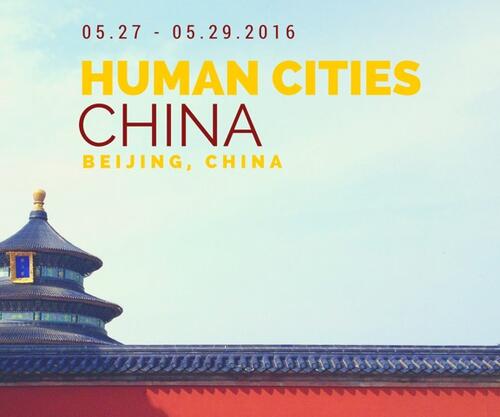
In May 2016, practitioners, researchers, and students will gather in Beijing, China for Human Cities@China to explore alternative pathways for an urban vision in China and one that ultimately creates a more sustainable and human-centered city. Drawing from the theme, Design, Build and Measure the Human City, we invite key experts to engage with American and Chinese students to share case studies and development models that promote urbanism at the neighborhood level. We explore the integration of new technologies and practices of community-scale infrastructure in both greenfield and infill development, as well as compare approaches to urban development in large cities and mid-sized townships. We will discuss how urban design strategies such as density, walkable streets, mixed land use, and small blocks can increase quality of life for people in daily interactions with their neighbors, community institutions, and the built environment. By learning from practitioners’ and developers’ firsthand experiences, attendees will meet new colleagues and collaborators, gain insights into the opportunities and challenges of urban development in China, and explore a framework to advance the human city.
When: Friday, May 27, 2016, 10 am to Sunday, May 29, 2016, 4:30 pm
Where:
* Friday, May 27 Human Cities@ China Kick-off at Tsinghua University
* Saturday, May 28 - Deep Dive in the Community at Tsinghua University
* Sunday, May 29 - Human Cities@ China Final Showcase at the Stanford Center at Peking University
Admission: Open to the public but registration is required. Register at https://deland.typeform.com/to/MvBiKA
Keynote Speakers:
Dr. Qin Shao, Professor of History, College of New Jersey, Author of Shanghai Gone
Stephen Wong, Managing Director for EWD, Chairman of Chongbang Group
Forum and Roundtable Speakers:
Liqun Chen, China Center for Urban Development, China Crowdsourcing Placemaker Initiative
Dr. Ying Long, School of Architecture, Tsinghua University, Beijing City Lab
Dr. Jing Jing Xu, China Development Bank Capital, Global Green Development Capital
Matthew Hu, Courtyard Institute
Amy Mathieson, China Building Restoration Project
Schedule: http://www.humancities.org/schedule
Speakers: http://www.humancities.org/speakers
Registration required for events open to the public
Register here: https://deland.typeform.com/to/MvBiKA
For more information, visit www.humancities.org/china
Human Cities@China is sponsored by the Stanford Office of International Affairs and organized by the Stanford Human Cities Initiative and Program on Urban Studies with support from Tsinghua University iCenter, Tsinghua Academy of Art and Design, Tsinghua University Department of Construction Management, the Stanford Center at Peking University, Stanford Bing Overseas Program, and the Urban Land Institute.
Speaking at the Stanford Center at Peking University (SCPKU) on September 22, Condoleezza Rice, the Denning Professor in Global Business and the Economy at the Stanford Graduate School of Business; the Thomas and Barbara Stephenson Senior Fellow on Public Policy at the Hoover Institution; and a professor of Political Science at Stanford University, said that technology and education are key drivers in achieving sustainable urban development and cited opportunities for China and other developing countries to harness this innovation and mobilize human potential.
Rice’s remarks were part of her keynote address during SCPKU’s inaugural Lee Shau Kee World Leaders Forum. Welcome remarks were given by Jean C. Oi, the Lee Shau Kee Director of SCPKU and Senior Fellow at Stanford University’s Freeman Spogli Institute for International Studies (FSI), and Peking University (PKU) Prof. Min Weifang and former PKU Chairman. Michael McFaul, Director and FSI Senior Fellow and former U.S. Ambassador to Russia, introduced Rice who highlighted the opportunities of technology and innovation as well as the governance challenges they can bring.
“If we remember technology is the application of knowledge to a problem, we can begin to address some of the problems of governing with the application of technology.” Rice said. “It is really a question of whether we can marry human potential and technological possibilities to solve our problems. Human potential is key to innovation, and in that regard, the most urgent tasks are around education.”
Rice spoke before an audience of 150 government and academic leaders, scholars, and students at SCPKU. Following her keynote address, she participated in a roundtable discussion with policy and thought leaders. The discussion was chaired by Karl Eikenberry, Director of the U.S.-Asia Security Initiative at Stanford’s Asia-Pacific Research Center and former U.S. Ambassador to Afghanistan. Panelists also included Dr. Wang Yiming, Deputy Director General and Senior Research Fellow at China’s State Council Development and Research Center, and Prof. Tong Zhu, Dean of the College of Environmental Science and Engineering at PKU.
“This was a unique opportunity to convene thought leaders on a topic of significant importance to China and the world,” said Prof. Oi. “China’s urbanization has been one of the most rapid in history. Technology innovation can help address the challenges of urban governance where people’s lives have changed in one generation.”

This is a test private event
Image

The Stanford Laptop Orchestra (SLOrk) is a computer-mediated ensemble and classroom that explores cutting-edge technology in combination with conventional musical contexts - while radically transforming both.
Stanford Center at Peking University
The Lee Jung Sen Building
Peking University
No.5 Yiheyuan Road Haidian District
Beijing, P.R.China 100871
Directions/Map
The Chinese government developed over 100 high-tech industrial development zones and over 80 university science parks since the mid-1980s, aimed to support fundraising and growth for innovation. How do they contribute to innovation in China? Are places like Zhongguangcun helping Chinese firms like the Silicon Valley? Professor Eesley will discuss his research on Science Parks as innovation policy in China and the channels through which ventures acquire financial and political support in China.
Professor Eesley is an SCPKU Faculty Fellow, the recipient of the National Natural Science Foundation of China (NSFC) 2012 Research Fund for International Young Scientists, and 2010 Best Dissertation Award in the Business Policy and Strategy Division of the Academy of Management. He has a doctorate from the MIT Sloan School of Management, and had been an entrepreneur in medical equipment innovation. His research focuses on how formal and informal institutions, and industry environment influence entrepreneurship.
Stanford Center at Peking University
Stanford Graduate School of Business
Knight Management Center
Stanford University
655 Knight Way
Stanford, CA 94305-7298
Godzilla Modular
340 Panama Street
Stanford, CA 94305
Rob Reich is professor of political science and, by courtesy, professor of philosophy at Stanford University. He is the director of the Center for Ethics in Society and co-director of the Center on Philanthropy and Civil Society (publisher of the Stanford Social Innovation Review), and associate director of the Institute for Human-Centered Artificial Intelligence. His scholarship in political theory engages with the work of social scientists and engineers. His newest work is on ethics and technology, and he has two books out in 2021: Digital Technology and Democratic Theory (edited with Lucy Bernholz and Hélène Landemore, University of Chicago Press) and System Error: Where Big Tech Went Wrong and How We Can Reboot (with Mehran Sahami and Jeremy M. Weinstein, HarperCollins). He is the author of Just Giving: Why Philanthropy is Failing Democracy and How It Can Do Better (Princeton University Press, 2018) and Philanthropy in Democratic Societies: History, Institutions, Values (edited with Chiara Cordelli and Lucy Bernholz, University of Chicago Press, 2016). He is also the author of several books on education: Bridging Liberalism and Multiculturalism in American Education (University of Chicago Press, 2002) and Education, Justice, and Democracy (edited with Danielle Allen, University of Chicago Press, 2013). He has written for the New York Times, Washington Post, Wired, and the Stanford Social Innovation Review.
Rob is the recipient of multiple teaching awards, including the Walter J. Gores award, Stanford’s highest honor for teaching. He was a sixth grade teacher at Rusk Elementary School in Houston, Texas before attending graduate school. He is a board member of the magazine Boston Review, of Giving Tuesday, and at the Spencer Foundation.