News Type
News
Date
Paragraphs


Anna Lembke, Assistant Professor of Psychiatry and Behavioral Sciences at the Stanford University Medical Center, visited SCPKU for two weeks as a faculty fellow in July 2014.  Below are the highlights of a conversation Professor Lembke had with SCPKU in which she shares more details about her research and how SCPKU helped to advance her work in China.


Q: Describe your research and its connection to China

My research focuses on improving the lives of those with addictive disorders. I am especially interested in the intersection between health care systems and culture, and how this intersection impacts addiction treatment. I became interested in studying drug use disorders in China for a number of reasons. First, I spent a year after college living in China (1989-1990) teaching English as part of the Yale China Program. I have followed events in China with keen interest ever since. Second, the total number of drug users in China may be as high as 7 million, with China predicted to have the most heroin users of any country in the world within 5 years. I was curious to find out how China is addressing its burgeoning drug problem, and didn’t just want the “party line.” I wanted to learn about how people addicted to drugs in China are seeking and getting help.


Q: What got you interested in the study of addiction?

When I first began practicing psychiatry, I was not interested in treating addiction. But over time, I came to realize that if I didn’t treat my patients’ drug and alcohol problems, their other mental health issues were unlikely to improve. I also realized that in targeting and treating addiction, I could help patients transform their lives for the better, as well as the lives of those who love them.


Q: Why did you decide to apply for an SCPKU Faculty Fellowship?

SCPKU gave me the financial and logistical support to pursue a research project in China, an opportunity that would not have been possible without their help.


Q: How valuable was SCPKU's team in supporting your fellowship at SCPKU?

The team here at Stanford was helpful with drafting the initial proposal, creating the budget, which was especially challenging, due to my lack of familiarity with what things cost in China, and making contact with the SCPKU staff in Beijing. The team in Beijing was helpful in setting up temporary housing and meals in Beijing, as well as providing maps, information on how to take the subway, and logistical support getting back to the airport.


Q: What were your fellowship objectives and were they met? 

My fellowship objective was to interview treatment-seeking heroin users in China to learn more about the state of addiction treatment in China. My research assistant, Dr. Niushen Zhang, and I planned to publish our findings in a peer-reviewed journal.

We learned that individuals in China addicted to drugs experience intense social stigma. They are reluctant to utilize government-sponsored treatment, because of fear of loss of anonymity and the ensuing social and economic consequences that follow when they are publicly identified as “addicts,” not to mention the potential loss of their personal freedom. (Addicted persons in China are sent against their will to forced detention centers, or “rehabilitation through labor camps.”) As a result, drug addicted persons in China are deeply mistrusting of government-sponsored treatment, and willing to sacrifice large sums of their own money for anonymous, confidential treatment.

Dr. Niushen Zhang and I recently published our findings in Addiction Science and Clinical Practice, 2015, “A qualitative study of treatment-seeking heroin users in contemporary China.” (To access the article online go to http://www.ascpjournal.org/content/10/1/23)


Q: Describe some highlights of your stay in China/SCPKU. 

The highlight for me was hearing the life stories of heroin-addicted patients at New Hospital in Beijing, and attending an Alcoholics Anonymous meeting, conducted entirely in Chinese. The AA members we met told us their participation in this grass-roots 12-step movement literally saved their lives. I also met many wonderful doctors and nurses working with addicted patients in China. Finally, Dr. Zhang and I became good friends. We had hardly known each other before venturing off to do research in China.


Q: List at least THREE words or thoughts that come to mind which best describe your experience at SCPKU. 

Compassion, endurance, overcoming adversity
 

Q: Any future plans in China? 

I’m thinking about taking a group of Stanford residents and/or medical students to China for a total immersion 3-week course to learn about addiction in China.  But not right away.


Hero Image
aa meeting 1
Professor Anna Lembke at an Alcoholics Anonymous meeting at New Hospital in Beijing summer 2014.
Courtesy of Stanford University
All News button
1
News Type
News
Date
Paragraphs

The leader of U.S. Pacific Command, Adm. Harry B. Harris, Jr., addressed U.S. nautical movements in the South China Sea while also calling for sustained military cooperation between China and the United States in a speech at Stanford Center at Peking University (SCPKU) on Tuesday.

Led by Ambassador Karl Eikenberry, a group of Stanford faculty and scholars from the Walter H. Shorenstein Asia-Pacific Research Center (APARC) listened to the speech from Stanford via an interactive, live videoconference at the Graduate School of Business. The speech was followed by a question and answer session, co-facilitated by Stanford professor Jean Oi in Beijing.

The admiral’s visit to SCPKU was part of a larger trip to China, which included discussions between senior Chinese and American military officials.

News media covered Admiral Harris’ remarks delivered at the SCPKU, which co-sponsored the event with Shorenstein APARC's U.S.-Asia Security Initiative. Articles appeared in the New York Times and Wall Street Journal (subscription may be required to view), among other publications.

Hero Image
image2
A group of faculty and scholars at Stanford participate in a videoconference with the leader of U.S. Pacific Command, Adm. Harry B. Harris, Jr., in Beijing on Nov. 3, 2015.
Ryan Blake
All News button
1
0
Graduate Student - East Asian Languages and Cultures
SCPKU Pre-Doctoral Fellow, September-November 2015
hangping_xu.jpg

Hangping Xu is a doctoral candidate at Stanford University, with two Master's degrees in Comparative Literature and Cultural Studies respectively. He is also pursuing a Ph.D minor in Gender and Sexuality Studies; additionally, he participates in Stanford's Digital Humanties lab, exploring the utilizations, in research and pedagogy, of visualization and mapping technologies. Transnational and interdisciplinary in its approach, his research focuses on modern and contemporary Chinese literature, film, and culture. His publications have appeared or are forthcoming in peer-reviewed journals such as Chinese Literature: Essays, Articles, Reviews (CLEAR), Critical Multilingualism Studies, and Pacific Affairs, as well as from Cambridge University Press (book chapter). He is currently completing his dissertation titled "Vulnerable Bodies as Agents: Disability Aesthetics and Politics in Modern Chinese Culture," which investigates the shifting representations and performances of the disabled body in Chinese fiction, film, and popular culture over the long twentieth century. Drawing upon, among others, political and moral philosophy, critical theory, cultural anthropology, performance theory, literary and cultural studies, the dissertation project tracks the hegemonic establishment, following the birth of the modern nation-state, of what can be called the ideology of ability (or ableism); it seeks to reconstruct disability in political, rather than pathological, terms, critically examining the manners in which the disabled body figures at the intersection of aesthetics, ethics, and politics. Not only does the dissertation aim to launch the minority identity of disability as a political concept for reconsidering Chinese modernity but also ultimately for revisiting theoretical paradigms, especially with regard to critical questions such as agency, embodiment, gender, sexuality, aesthetics, citizenship, and social justice. His papers have been presented at major conferences such as the American Comparative Literature Association annual meeting, the International Society for the History of Rhetoric biennial conference, and the Modern Language Association annual convention (scheduled). He has taught language, literature, film, writing and rhetoric classes at the college level for more than six years. In 2015, he won the Centennial Teaching Award from Stanford University. The other distinctions and awards that he has received include the Silas Palmer Research Fellowship from the Hoover Institute, the Best Presentation Award from the Chinese Language Teachers Association of California (CLTAC) annual conference, and the Mori-ASPAC Best Paper Prize from Asian Studies on the Pacific Coast Annual Conference.

Authors
News Type
News
Date
Paragraphs

Mike McFaul's public talk at SCPKU July 6, 2015


FSI Director and SCPKU Mingde Distinguished Faculty Fellow Mike McFaul shares with SCPKU intern Nathalie Chun key insights during his month-long academic residence at the Stanford Center at Peking University (SCPKU) this summer.


What is the purpose of your current visit? Could you tell us about your experiences and findings?

Michael McFaul: My main intellectual interest was to understand more about Chinese foreign policy and in particular the bilateral relationship between China and the US but also the bilateral relationship between China and Russia. I’m thinking of writing something, a new project, about this trilateral relationship. And so I spent the most of my time over the last several weeks speaking to two sets of people that are very different: those that focus on United States and those that focus on Russia. In addition, I have an interest in the politics of economic reform and the politics of political reform so I’ve also been speaking to academics, business people, and a few journalists to talk about the change that is going on here in China both on the political and economic dimensions


Is there in particular that you’ve learned about here in China that has surprised you? You’ve mentioned that you’ve talked to many different people so I was wondering if there was anything in particular that made you go ‘Oh that’s really interesting!’

MM: That’s good question. In terms of my subject matter, the thing that was most interesting to me as a concept of dual rising powers. So, the conventional wisdom is that China is rising and the rest are fading. But one academic, and it actually came up more than once, reformulated that idea. It’s not that China is rising and everybody else is fading, it’s actually that the United States is rising with China, just at a slower pace. And so maybe eventually they catch up, but it’d be incorrect to say that one is declining and that one is rising, and vis-á-vis the rest of the countries in the world. I also think that’s a better formulation because actually the United States continues to grow at a higher rate. It still has the largest military in the world; in terms of soft power [it still] has great reach and that has not been declining, that’s still rising. It’s just that when we look at this rate of change relative to the rate of change in China, the United States feels like it’s falling behind. Or China is catching up is a better way to put it. I thought that was interesting.

Second interesting point is, you know I just spent two years as Ambassador to Russia from the United States, and there I would say there is a feeling of… envy towards the United States. Like we have wronged them or that we are guilty for some of the difficult periods that they have had, kind of like a chip on their shoulder. Here I don’t feel that. Here I see a kind of self-confidence that people have, wanting to work with United States. Most certainly when I met with officials there was a very strong sense of wanting to have cooperative relations with the United States and in particular it jumped out at me when I was at the Ministry of Foreign affairs yesterday, they kept using the phrase ‘win-win outcomes’ for China and the United States. Well that’s exactly what we’re trying to do with Russia when I was in the government; during the early period of the Obama administration we used that phrase too. And I find it interesting that here the bilateral relationship with China, the Chinese still talk about that, and most certainly do the Americans too. I met with Ambassador Baucus and his team, and they most certainly talk that way. I find it kind of tragic that in the bilateral relationship with Russia, we no longer talk that way.


You’ve just mentioned the whole idea of zero-sum perspective of looking at the world and I guess in IR theory that would be a more realist perspective, as opposed to a liberalist perspective. So do you think that this sort of liberalist perspective should the future of looking at and that this ‘win-win’ perspective is one that future diplomats should hold?

MM: I worked on the Obama campaign in 2008 and one time on a flight with him when I was briefing him, I started to talk about these two camps, realist and liberal camps, as a way to understand foreign policy and you know how he responded to me? He said “Come on, the real world, requires you to use both of those theories depending on the issue and the country and the bilateral relationship” and when I was in the government, I most certainly felt that way. These are useful paradigms to kind of clarify arguments but I wouldn’t want to be labeled in one camp or the other and I think it’s analytically distorting, not revealing, to say the world is either realist or liberal. That said, I lean towards liberalism personally. I do believe in the 21st Century, maybe not early centuries it was possible, but in the 21st Century it is possible to construct outcomes that are good for both countries especially through the use of treaties and institutions. And I come away from my month here in China feeling that there are real challenges in the bilateral relationship, complicated issues, but they’re not irreconcilable issues. Even South China sea right, even Taiwan, I see the possibility, with smart diplomacy, that we can find ways to manage these issues so that it doesn’t lead to conflict between the United States and China


While you were here at SCPKU you have given talks on both the upcoming US elections and current US-Russia relations. Putting those two themes together, what do you think are the implications of the current US-Russia relations on the upcoming elections in 2016 and the way the next president will tackle these issues?

MM: I would say, I predict continuity, more or less. That is to say, that the policy that you see now was a reaction to Russia annexation of Ukraine, of Crimea, and intervention in Eastern Ukraine, is one of deterrence and punishment. There are three dimensions to it: sanctions to punish Putin’s bad behavior, strengthening of NATO to deter him from going further and third, shoring up Ukraine to try and make the economy there recover from this very difficult period. And I basically think those three main policy trajectories will continue, I don’t see a change. But in each one of them, you might see more or less the same paths. I predict that if a Republican candidate is elected, the ones who’s policies I know, or even Secretary Clinton, you would see for instance maybe military assistance to Ukraine, which is something the Obama administration has so far been reluctant to do, but I don’t foresee major change. And that disappoints people here in China. When I say that they are disappointed, it is because they are hopeful after an election there might be a new president that may try to reset relations with Russia again. I’m not optimistic.


What roles, in your opinion, is SCPKU playing in China, and what do you hope the Center will achieve in the future?

MM: Well what I hope the Center will achieve for the future is to create greater connectivity between hundreds of Stanford scholars working in all fields. This is an incredible place, I’ve never seen it before until this trip, absolutely beautiful, 21st century technology, and the second thing is, Peking University is an incredible university, beautiful campus, really all of my interactions with scholars here have been very positive, they’ve been very warm in greeting me as a fellow scholar and I’ve been impressed by the students as well. So that is my hope, over the coming years and decades, that this serves as a bridge between PKU, but also all of China, and Stanford University because there are many difference issues in all different fields of study where there’s room to cooperate. In my field, I also see a very concrete role to help develop what we call Track II dialogues, with China scholars, in terms of helping to manage US-China bilateral relationships. It’s very clear to me there’s a close relationship between senior scholars here at PKU and the government and the Party and the business community and the People’s Congress. I’ve met many people and they know all the people here and we have those connections in terms of Washington as well at Stanford. So my hope is that in a concrete way, and for me personally, that I might be involved in that, and we have an incredible platform here to be able to do so.


Hero Image
mike mcfaul talk 7 6 15 Courtesy of Stanford University
All News button
1
News Type
Blogs
Date
Paragraphs

By Donna Norton


When my husband, Michael McFaul, proposed spending part of the summer with our kids (ages 17 and 12) at the Stanford Center at Peking Univeristy in Beijing, I was a little apprehensive.  What would the kids do?  Visions of a chaotic, hot and smoggy megalopolis flashed through my brain.  If you are considering spending some time at Peking University, you may be having these fears too.  For the sake of you, the unknown reader with restless kids, I’m writing this blog post to encourage you to make the trek.  Yes, there were definitely days when the smog kept us inside, but we still had a fantastic time.  So, in David Letterman style, here’s my top ten list of reasons why Stanford’s PKU Center is a great place for kids:

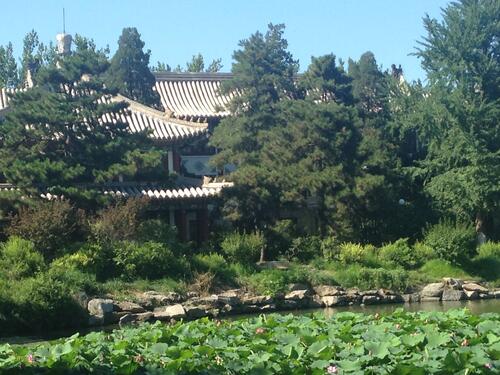
1)   Where else can you get up in the morning and take walk in the shadow of a pagoda around a beautiful lake filled with water lilies?  The biggest surprise for me was how beautiful and peaceful the Peking University campus is.

2)   Chinese food!  My kids fell in love with Chinese food.  By the end of our trip, my son was asking for noodle soup for breakfast and complaining when I gave him a fork instead of chopsticks to eat it with.

3)   Riding a toboggan down the Great Wall of China!  Yes, it’s true, you can take a chair lift up to the Great Wall of China and toboggan down.  (We figured it was safe because there were photos of Michelle Obama riding the toboggan so it must have been cleared by the Secret Service.)

4)   Air conditioning!  Yes it hot in Beijing, but we had great air conditioning in our apartment and cars and restaurants are almost all air conditioned so we didn’t spend that much time sweating. 

5)   Chinese language!  The Stanford Center helped us find a Chinese language teacher for our kids and they loved their private lessons.

6)   Exotic and scary food at the Beijing Night Food Market – nothing builds your street cred with teenagers faster than posting photos on Instagram of live scorpions on a shish-kabob.

7)   Cool internship opportunities!  Our high school age son had a very cool and unique internship in Beijing. 

8)   A break from the drudgery of cooking!  We walked to restaurants for lunch and dinner every night from our apartment on campus because why bother cooking when the restaurants are so cheap and good? 

9)   Places to work off the daily Peking Duck calories!  If you want, there are gyms within walking distance from the apartments.  And if your kids would rather surf the internet than exercise, there’s wi-fi at the apartment we stayed at and at the Stanford Center.

10)    China!  The Stanford Center at Peking University happens to be located in China, which is an amazing country with a fascinating history, culture, and otherworldly natural beauty.  Definitely an enriching and unforgettable experience for the kids and adults!

My advice?  Don’t miss it!  If you have questions, feel free to contact me at donna@momsrising.org.


Image
packard house

The view of our partment building and the water lilies
Photo credit:  Donna Norton


Image
scpku entrance

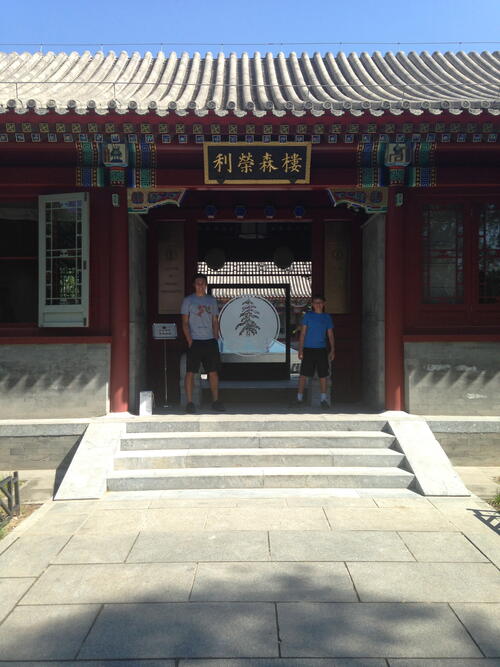
Arriving at the Stanford Center at Peking University
Photo credit:  Donna Norton

Hero Image
mcfaul family Donna Norton
All News button
1
News Type
News
Date
Paragraphs

A three-week seminar focused on digital health innovation and entrepreneurship in China came to a close last week, culminating in the final pitch presentations from four cross-cultural, entrepreneurial student teams. The winning team, LiveBright, presented a way to improve access to personal counseling in China using digital, peer-to-peer methods, with the mission of reducing stress among students and young professionals.

Sponsored by the Stanford Center at Peking University (SCPKU), the course was developed by Dr. Robert Chang, digital health inventor and Assistant Professor of Ophthalmology at Stanford University, and Ravi Pamnani, medical technology executive and alumnus of Stanford’s Biodesign Innovation Fellowship, a pioneering training program in biomedical innovation.

The hands-on course paired Stanford students with Peking University students in collaborative teams and immersed them in the Chinese healthcare system. Students shadowed physicians and interviewed patients to identify unmet needs and market opportunities. Students then brainstormed solutions and developed rapid prototypes to test their ideas and obtain user feedback. Next, they selected business models to ensure the sustainability of their solutions. Along the way, students got feedback from physicians, digital health entrepreneurs, and investors who evaluated their ideas in real-world contexts.


rob and ravi compressed SCPKU seminar instructors, Dr. Robert Chang and Ravi Pamnani.

SCPKU seminar instructors, Dr. Robert Chang and Ravi Pamnani
Courtesy of Stanford University


Other teams focused on a telemedicine approach to physical therapy, a more convenient way to obtain eyeglasses prescriptions at home, and a novel subscription box service to promote women’s health education.

“We have been really impressed with the outside-the-box thinking that the students have employed to identify new opportunities,” said Dr. Chang. “China has seen tectonic changes in the mobile and consumer internet sectors. With this in mind and given the unique characteristics of the Chinese healthcare system, a digital health revolution is inevitable, and in many ways has already begun. The rest of the world can learn a lot by observing how digital technologies will transform healthcare here in China over the next five years.”

For more information about the seminar, visit http://www.dhealthchina.com/.

Hero Image
group photo resized Courtesy of Stanford University
All News button
1
News Type
News
Date
Paragraphs

Image
viewimage


Hua Tang, Stanford Associate Professor of Genetics, visited SCPKU as a faculty fellow in March 2015.  Below are the highlights of a conversation Professor Tang had with SCPKU in which she shares more details about her research and the contributions SCPKU made to her work in China.


Q: Describe your research and its connection to China

My research aims to develop statistical and computational methods for elucidating the genetic basis of human complex diseases. My current focus is on two related themes: identifying disease risk factors by integrating functional genomic information, and understanding factors that contribute to differential disease prevalence across human populations. My SCPKU faculty fellowship has given me the opportunity to explore new dimensions related to both themes.  Through connections I have made with scholars at Peking University (PKU), I will be able to combine biological knowledge and population-based association evidence in my efforts to identify genetic risk factors for complex diseases.  I also plan to compare epidemiologic data based on the East Asian population in the U.S. and epidemiological studies in China to understand the role of life-style risk factors, such as diet and physical activities, in ethnic health disparity.


Q: What got you interested in the study of human complex diseases?

I have always enjoyed mathematics, but it is very important to me that my work has direct benefit to people. Luckily, in college and during graduate school, I discovered that statistical and population genetics are areas in which I could use mathematical tools to gain insights relevant to human health. We are living in an era of big data; combining novel statistical models, efficient computational tools and large-scale biomedical data offers fantastic opportunities to make real contributions to medicine and public health.


Q: Why did you decide to apply for an SCPKU Faculty Fellowship?

I wanted to connect better with the scientific community in China.  I had already started communicating remotely with a PKU professor at PKU, whose research shares common goals with mine but who takes complementary approaches. The SCPKU faculty fellowship would allow me to travel to China and strengthen ties with faculty at PKU.  I also look forward to the opportunities of interacting with students at PKU.


Q: How valuable was SCPKU's team in supporting your fellowship at SCPKU?

Extremely valuable!   I got a nice office on the courtyard level, great IT and staff support. Also, I had the opportunity to interact with faculty from other departments for collaborations.


Q: What were your fellowship objectives and were they met?  Also, if applicable, aside from the fellowship, how did SCPKU help you to achieve your objectives?

My first visit to SCPKU in March was very productive and I was able further my research on the two themes I mentioned earlier.  I also taught a lecture in a concurrent SCPKU graduate seminar, through which I got to know the work of Professor Randall Stafford from the Stanford Prevention Research Center.  Professor Stafford was also an SCPKU faculty fellow and taught a graduate seminar at SCPKU this past spring focused on chronic disease in China.  I was able to participate in the seminar and establish new ties with instructors and participants of this  multidisciplinary seminar including Chinese scholars, health practitioners and government representatives from the Chinese Center for Disease Control and other health-related organizations. 

Being physically at SCPKU this past spring really helped to stimulate my research program. The fellowship has opened up many possibilities for interacting with scholars at Peking University and the broader scientific community in Beijing. I hope to expand these relationships by making several more trips to SCPKU. I am also very interested in organizing an SCPKU graduate seminar for the near future.
 

Q: Describe some highlights of your stay in China/SCPKU. 

Aside from meeting with my PKU contacts to further my research, I enjoyed participating in (both as an observer and teaching a lecture) Dr. Stafford’s graduate seminar on chronic diseases in China. I made many new connections in the Beijing science community and will host a visiting student in early 2016.  I also attended an SCPKU-hosted happy hour which included a Chinese rice wine tasting and musical performance on a Chinese zither or “guzheng.”


Q: List at least THREE words or thoughts that come to mind which best describe your experience at SCPKU. 

Adventure, exploration, collaboration.
 

Q: Any future plans in China? 

I plan to use the remaining funds from my SCPKU fellowship in the fall, and continue interaction with faculty at PKU and SCPKU.


Photo courtesy of Stanford University

Hero Image
viewimage Courtesy of Stanford University
All News button
1
-

Over the last years, a paradigm shift in Heidegger research has been gaining momentum in the United States. The paradigm shift is motivated by and strictly based on the entirety of Heidegger's works, and especially the posthumous publications from 1989 to the present. It moves beyond the "classical paradigm" established by such scholars as William J. Richardson, Otto Pöggeler, and Friedrich-Wilhelm von Herrmann. This lecture lays out the main features of the paradigm shift and raises questions for discussion about how this reformulation of Heidegger's project might enter into dialogue with contemporary Chinese scholarship on Heidegger.
 

Thomas Sheehan, Ph.D., is professor of Religious Studies and, by courtesy, Philosophy at Stanford University. His field of specialization is contemporary phenomenology, especially Heidegger, as well as classical Greek and medieval philosophy. His doctorate was awarded by Fordham University, New York, where he studied under the renown Heidegger scholar William J. Richardson.

Thomas Sheehan Professor of Religious Studies Stanford University
Lectures
News Type
News
Date
Paragraphs

On May 29, SCPKU announced a new faculty team-based program, the Team Innovation Faculty Fellowship Program (TIFF), to spark creative, multi-disciplinary approaches to research in China targeting topics of key interest to Stanford, the U.S. and China. TIFF awards provide support for up to $30K per team for "proof of concept" project expenses.  There are two application cycles per year; the first application deadline is July 15, 2015.  See the program website for more information.

Hero Image
sckpu class smiles ms Steve Fyffe
All News button
1
Subscribe to China