Authors
News Type
News
Date
Paragraphs

A new course jointly taught by Stanford and Peking University brought together students and scholars in China and the United States in dialogue using videoconferencing.

Each week during the past spring quarter, students at Stanford and Peking University (PKU) gathered in a classroom to learn, just as they would for any other course. The only difference was these students were neither in the same classroom nor on the same continent.

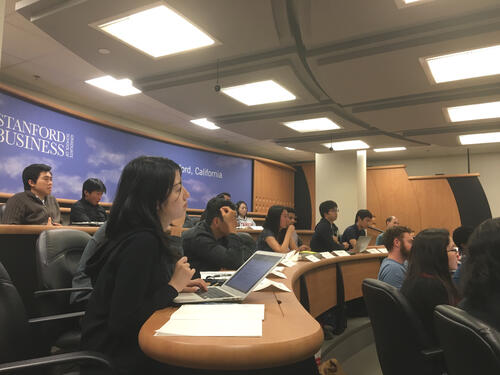
Despite being separated by nearly 6,000 miles, 18 students in Palo Alto and 28 students in Beijing held ‘face-to-face’ conversations via high definition videoconference in a course taught by American and Chinese scholars. On each side, they sat in a three-rowed amphitheater and looked directly ahead – not at a whiteboard – but at a screen that projects a video ‘wall’ of their colleagues at the other campus. The venue, known as a ‘Highly Immersive Classroom,’ enabled the distance learning experience between the two universities, using advanced software to create a cross-Pacific virtual classroom. The course titled The United States, China, & Global Security, led by former U.S. Ambassador to Afghanistan Karl Eikenberry and PKU professor Fan Shiming, was organized under the auspices of the U.S.-Asia Security Initiative whose research focuses on security challenges in Asia with teaching as one of its core activities.

“We set out to host a course that addressed topics critical to China and the United States in a new type of classroom format,” said Eikenberry, the Oksenberg-Rohlen Distinguished Fellow in the Shorenstein Asia-Pacific Research Center and director of the Initiative. “What resulted was a truly unique academic exchange that considered topics even beyond the bilateral relationship and carried a certain ‘Silicon Valley spirit’ being divided by an ocean yet connected through technology.”

“I loved the cybersecurity class because there was a lot of candor on both sides.”

-Shan Jee Chua, PKU graduate student

Over eight weeks, a select group of graduate students from the two universities explored a wide array of subjects related to international security, ranging from terrorism to trade and energy and the environment. The course aimed to provide students with a forum to discuss current issues in U.S.-China relations and to analyze areas that could be applied to other case studies. 

“Because each week was a different topic, it didn’t feel like I was just thinking about the United States and China again every Wednesday night,” said Sam Ide, a Stanford graduate student who studies China’s relations with Central Asia. “Each session was very interesting to me in a different way.”

Guest-taught by prominent scholars and former senior government officials from the United States and China, the course sessions allocated thirty minutes for each lecturer to present, followed by a thirty minute question-and-answer period in which students were given the opportunity to interact with the lecturers and their peers on the other campus. Lecturers from Stanford included nuclear scientist Siegfried Hecker, former U.S. Secretary of Energy Steven Chu, and Thomas Fingar, a former deputy director at the U.S. Office of the Director of National Intelligence; and from PKU, Dean of the School of International Studies Jia Qingguo, and arms control and disarmament expert Han Hua. All discussions were off-the-record to encourage candid exchange of ideas. 

Image
course 3

At Stanford's Highly Immersive Classroom in Palo Alto, students look ahead at their counterparts in Beijing.


One course session in particular resonated with students. The session, taught by Zha Daojiong, a professor of political economy at PKU and Herbert Lin, a senior research scholar at Stanford’s Freeman Spogli Institute for International Studies, focused on the changing nature and future of cybersecurity relations between China and the United States.

“I loved the cybersecurity class because there was a lot of candor on both sides,” PKU student Shan Jee Chua recalled.

Kimberly Chang, a second year Stanford graduate student in management science and engineering, noted that it was beneficial to hear the Chinese view on cyber “because most of the talk within the United States has been from an American perspective.”

“Hopefully, I'll be able to meet some of these people in real life who I've met on the 'wall.'”

-Sam Ide, Stanford graduate student

The course revealed a broader range of perspectives and provided a chance to interact first-hand with international colleagues while remaining at their home campus. Discussion amongst peers uncovered the “behind the scenes stories” and added context to media reports found online or in print, said Seung Kim, a student in Stanford’s East Asian studies program.

Besides the technology, a unique aspect of the course was its diversity. More than half of the course participants were international, representing 15 countries beyond China and the United States. That setting encouraged debate and reinforced the notion that “neither the United States nor China is the center of the universe,” said Zhu Jun Zhao, a PKU international relations student.

When students were asked what could bring about better understanding between China and the United States, continued dialogue was a common answer. The future of U.S.-China relations rests in the hands of people talking to one another: “I think we need more honest conversations,” Chang said.

And for some students, an opportunity to hold those conversations in-person may be close. Ide said he anticipates traveling to Beijing over the summer and plans to try and meet with a few of his counterparts whom he met through the course.

“Hopefully, I’ll be able to meet some of these people in real life who I’ve met on the ‘wall.’”

Related Links:

Video showcases SCPKU's Highly Immersive Classroom enabling co-teaching across the Pacific

Hero Image
course 2
At the Stanford Center at Peking University in Beijing, Peking University professor Fan Shiming presents his remarks during a session of "The United States, China, & Global Security," a joint course taught by Stanford and Peking University via videoconference; Palo Alto, May 2016.
All News button
1
-

Speakers: 

Randall Stafford, MD, PhD, Professor of Medicine (Preventive Medicine), Stanford University
Judith Prochaska, PhD, MPH, Associate Professor of Medicine (Health Psychology), Stanford University
Mike Baiocchi, PhD, Assistant Professor of Medicine (Research Design), Stanford University

Multiple factors have led to China’s increasing burden of non-communicable diseases, including population aging, globalization of dietary patterns, urbanization, sedentary lifestyles, etc.  The country faces new challenges that strain existing health systems and have spawned multiple healthcare reforms. Yet, prevention strategies offer great hopes as China works to tackle such conditions as hypertension, diabetes, heart disease, stroke, and cancer.  While China’s situation is of unique magnitude, much of the world is struggling to cope with the increasing burden of cardiovascular disease and cancer.  Much could be gained by examining China’s predicament and its response to its chronic disease epidemic.

Experts from both the United States and China will discuss the issue from the following perspectives: well-being – an upstream preventive approach, tobacco and emerging nicotine product, how to become the top country in health research, cancer prevalence and geographic information system. This symposium is also the culmination of the seminar series – “Cardiovascular Disease and Cancer Prevention in China” at the Stanford Center at Peking University. Three student groups will also present their solutions to the problems of preventing obesity among male college students, salt-reduction in university student diets, and prevention of the initiation of smoking in adolescents. 

Theis event is open to the public. Please RSVP with Mr. Zhang Sanjiu: sanjiu39@stanford.edu


9:00 – 9:20

Opening Remarks:  The Social Geography of NCDs


Randall S. Stafford, MD, PhD

9:20 – 9:50

Guest Speaker from Cancer Hospital


Lei Yang

9:50-10:10

Tobacco and Emerging Nicotine Products: from the East and West


Judith Prochaska, PhD, MPH

10:10 – 10:30

How to Become the Top Country in Health Research


Mike Baiocchi, PhD

10:30 – 10:50

Coffee Break


10:50 – 11:00

WELL-China: A New Approach to Prevention Research


Randall Stafford, MD PhD

11:00-11:05

Introducing the SCPKU Seminar and the Project Reports


Yan Min, BM MA

11:05-11:25

SALT: Students and Labeling + Technology


Student Team 1

11:25 – 11:45

A Phone App-Based Behavioral Intervention for Overweight/Obesity Prevention in Chinese Males at the University Transition


Student Team 2

11:45-12:05

The Effect of Limiting Adolescents’ Exposure to Parental Smoking on Adolescent Girls’ Smoking Incidence and Attitudes Towards Smoking


Student Team 3

12:05 – 12:10

Concluding Remarks


Jodi Prochaska, PhD, MPH

12:10 – 1:30

Lunch


Lee Jung Sen Building, Langrun Yuan

No. 5 Yiheyuan Road, Haidian District 

Beijing, China


Symposiums
-

Stanford University’s Center for East Asian Studies presents “China Arts Forum” at the Stanford Center on July 2, 2016.  The event will explore contemporary arts development in China and feature three visual artists and one performing artist, all of them women. Each artist will introduce her creative process and unique approach to her art form. This will be followed by a panel discussion focusing on contemporary arts and society in China.  The renowned pipa player Zhao Cong will showcase her newly created works to conclude the event.


Widely recognized as a global economic juggernaut and nascent political power, China is on the cusp of becoming a major cultural power.  In the arts field over the past two decades, cities across China have built state-of-the art museums, opera houses, and concert halls to both foster and showcase their cultural heritage. Arts education is increasingly popular.  Many inspirational artists are now the toast of the international art world and “Chinese Contemporary" is one of the most rapidly appreciating segments of the global art market.


The Stanford Arts Forum will be hosted by Professor Jindong Cai from Stanford’s Center for East Asian Studies. It is hoped that this forum will become a platform for exploring visual and performing arts in America and China, and for creating a vibrant dialogue on arts and culture.


The event will begin with three vibrant visual artists who will share the podium to discuss their works and views.  Jiang Jie is an artist and professor at the China Central Academy of Fine Arts.  She will focus on three of her works in order to explore how an artistic creation can continue to change and evolve.  Cui Xiuwen has just opened a multi-media exhibition in Peking University called “Light.”  Using sculptures, videos, animation and one painting, she will discuss her exhibition and share the view on her approach to light through body, heart, soul, and fate.  Chen Man is one of the most celebrated photographers in China and her topic is “the philosophy of images.”  Jinqing Cai, chairman of Christies’ China, will moderate the panel discussion following each individual’s presentation. Ms. Cai also will give her view of China contemporary arts. 


The renowned pipa player Zhao Cong was a visiting artist/scholar at Stanford University in 2014.  She is a strong advocate for creating new music to combine Chinese tradition with the world of contemporary music. She will demonstrate and perform some of her new pieces that merge east and west on the ancient instrument. 


This event has been organized especially for Stanford alumni in Beijing, but is also open to the general public.

To register, please visit: 

http://web.stanford.edu/~kkutella/BeijingPublicTalk2016.fb


Stanford Center at Peking University 

Langrun Yuan, Peking University


Conferences
-

The Hoover Institution on War, Revolution, and Peace was founded nearly 100 years ago as the Hoover War Library with a donation by Herbert Hoover, who later said, “This Institution is not, and must not be, a mere library, but…must dynamically point the road to peace, to personal freedom, and to the safeguards of the American system.”  Since its founding, the Hoover Institution has grown into one of the most prominent global research centers (“think tanks”) and the only one with a world class Library & Archives as its foundation. Today Hoover supports hundreds of fellows in disciplines including economics, history, political science, and the humanities, while maintaining a Library & Archive that is among the largest in the United States with almost 7,000 archival collections in more than 150 languages. The Library & Archives draws over 10,000 visitors annually to its reading rooms, events, exhibits, scholarly conferences and workshops. Eric Wakin, Deputy Director of Hoover and the Robert H. Malott director of its Library & Archives, will discuss the rich history of this unique Institution and where it will be headed in its next hundred years.

胡佛研究所(全称“胡佛战争、革命与和平研究所”)成立于近一百年前,最早称作“胡佛战争图书馆”,由赫伯特·胡佛(后来任美国第31届总统)创建。他曾说,“这个研究所绝对不能仅仅是一个图书馆,还应指引美国的和平、自由之路,同时捍卫美国的制度”。自创立以来,胡佛研究所已经成长为全球著名的研究机构(智库)之一,也是唯一自建立之初拥有世界级图书与档案馆的研究所。如今,胡佛研究所支持几百位来自不同领域的研究者进行研究,包含:经济学、历史学、政治学以及其他人文学科,同时维持图书与档案馆的运营。作为美国最大的图书与档案馆之一,胡佛档案馆内拥有150多种语言的7000多类档案文件,每年能够吸引上万名读者来到阅读室、展览区参加学术会议和工作坊。Wakin教授作为胡佛研究所副所长、胡佛研究所图书与档案馆馆长,将会探讨胡佛研究所的丰富历史,并展望研究所未来百年的发展方向。


Eric Wakin is the deputy director of the Hoover Institution and the Robert H. Malott Director of the Institution’s library and archives, overseeing their strategic direction and operations. Wakin is the author of Anthropology Goes to War: Professional Ethics and Counterinsurgency in Thailand. His current research interest is guns and gun control in the nineteenth-century United States and he is revising a manuscript titled "From Flintlock to ‘Tramps’ Terror’: Guns and Gun Control in Nineteenth-Century New York City.” He has also coauthored a number of walking-tour books and travel guides. Before coming to Hoover, Wakin was the Herbert H. Lehman Curator for American History and the Curator of Manuscripts at the Rare Book & Manuscript Library at Columbia University, where he also taught courses in the History Department on public history, memory and narrative, archives and knowledge, and theory.


Wakin教授为美国斯坦福大学胡佛研究所副所长、胡佛研究所图书与档案馆馆长,负责胡佛研究所战略规划和设计。Wakin教授著有《人类学走向战争:泰国的职业伦理与叛乱镇压》(Anthropology Goes to War: Professional Ethics and Counterinsurgency in Thailand.)。他最近的研究方向为19世纪美国的枪支及其管控,正在修订一篇题为《从老式火枪到“流浪汉”的恐惧:19世纪纽约城的枪支及其管控》(From Flintlock to ‘Tramps’ Terror: Guns and Gun Control in Nineteenth-Century New York City)的书稿。任职胡佛研究所之前,Wakin 教授是哥伦比亚大学莱曼美国历史中心主任、哥伦比亚大学珍本与手稿图书馆馆长。同时,他也在哥伦比亚大学历史系教授有关公共历史、记忆与叙事、档案的课程。Wakin教授先后于密西根大学和哥伦比亚大学获得硕士、博士学位,并先后为数十家企业提供企业战略发展、运筹规划的咨询。


Stanford Center at Peking University 

5 Yiheyuan Road, Beijing, China 


Eric Wakin Deputy Director of the Hoover Institution and the Robert H. Malott Director of the Institution’s library and archives
Lectures
-

This forum will focus on the importance of community health services and primary health care reform in China and discuss the deepening efforts to establish a two-way referral system to help boost access and equality of high-quality medical resources and basic public health services.  At this year’s annual forum, distinguished experts will present research examining China’s emerging hierarchical medical system (including insurance payments, referral arrangements, and chronic and acute disease treatment initiatives). Policymakers, providers, and researchers will introduce China's overall policies towards this new system as well as describe the practice and challenges of primary care delivery and innovative approaches of internet-based and integrated medical care systems.

Presentation English
Download pdf
Xiaofang Han Former Director of Beijing Municipal Development and Reform Commission
Xinbo Liao Inspector of The Health and Family Planning Commission of Guangdong Province
Jifu Zhan Deputy Mayor of Sanming, Fujian province
Su Xu Deputy Director General of Shanghai Health and Family Planning Commission, Director of Shanghai health care reform office
"and other speakers; please see agenda"
Workshops
News Type
News
Date
Paragraphs

Stanford University's Asian Liver Center (ALC) and the Global Business Group on Health jointly hosted the inaugural JoinJade for China Summit and Awards Ceremony at SCPKU on April 22, 2016.  29 major employers committed to a hepatitis B discrimination-free work environment were recognized at the event.  Lenovo, General Electric and IBM also participated in an employer panel to discuss key strategies for a discrimination-free work environment and next steps.


Image
employer panel

JoinJade for China is a joint initiative involving global organizations including the ALC in the U.S. and China, Global Business Group on Health, IBM, General Electric, Intel, Hewlett Packard Enterprise, and HP Inc.  The initiative focuses on building fully inclusive workplaces free from hepatitis B discrimination.  

Image
joinjade award


Image
joinjade award 2


The ALC at Stanford University is the first non-profit organization in the U.S. that addresses the disproportionately high rates of chronic hepatitis B infection and liver cancer in Asians and Asian Americans.  Founded in 1996, the center addresses the gap in the fight against hepatitis B through a four-pronged approach of collaboration, advocacy, research, and education and outreach (CARE).  The ultimate goal of the ALC is to eliminate the transmission and stigma of hepatitis B and reduce deaths from liver cancer and liver disease caused by chronic hepatitis B.


Photos courtesy of Stanford University's Asian Liver Center

Hero Image
group photo Courtesy of Stanford Asian Liver Center
All News button
1
-

Image
rsvp picture


Founded in 1996, Asian Liver Center at Stanford and Peking Universities (ALC) are devoted to the elimination of transmission, stigma, and deaths associated with chronic hepatitis B and liver cancer.  On April 22, 2016, ALC will co-host the JoinJade for China Summit: Building Inclusive Workplaces at the Stanford Center at Peking University. 28 leading multinational employers in China will be recognized for their commitment to the JoinJade for China initiative to build healthy, inclusive workplaces free from hepatitis B discrimination.

Summit Agenda

9:00                 Reception

9:30                 Welcome

                          Emcee: Dong Qian, CCTV anchorwoman

9:35                 Opening remarks

                          Dr. Samuel So, Director, Asian Liver Center

                          Jayne Lux, Vice President, Global Business Group on Health

9:50                 Keynote speeches

                          Dr. Bernhard Schwartländer, WHO Representative in China

                          Dr. Fuqiang Cui, Deputy Director, China CDC National Immunization Program

10:05               Tea break

10:20               Panel discussion

                          Dr. Samuel So, Director, Asian Liver Center

  Dr. Tong Chen, Consulting Occupational Physician, Integrated Health Services, IBM Greater China

                          Dr. Jean Wu, Medical Director, GE China

                          Mr. Chuang Lei, Founder, Yiyou Charity

                          Q & A

10:55              Launching Ceremony

11:05              JoinJade for China Awards Ceremony

11:25              Group picture

11:40              Lunch


For questions, please contact:

Email: xiaojuny@stanford.edu

Phone: +86 (10) 62744167

5 Yiheyuan Road

Haidian District, Beijing

China


Conferences
News Type
News
Date
Paragraphs
The Stanford Center at Peking University announced its newest faculty and pre-doctoral fellows and graduate seminars from the latest January application round.  
 
Team Innovation Faculty Fellows:
 
  • Randall Stafford - Professor, Stanford Prevention Research Center, June-July 2016
  • Judith Prochaska - Associate Professor, Stanford Prevention Research Center, June-July 2016
  • Michael Baiocchi - Assistant Professor, Stanford Prevention Research Center, June-July 2016

See SCPKU Team Innovation Faculty Fellowship Program and SCPKU Team Innovation Faculty Fellows for more program details.


Faculty Fellows:
 
  • Karen Eggleston - Senior Fellow, Shorenstein APARC/FSI, June and August 2016
  • Olivier Gevaert - Assistant Professor, Biomedical Informatics, August-September 2016
  • Jianghong Rao - Associate Professor, Radiology, June 2016
 

Pre-Doctoral Fellows:
 
  • Rick Fenrich - Aeronautics and Astronautics, July-August 2016
  • Colleen Shang - Materials Science and Engineering, July-August 2016
  • Shiran Shen - Political Science, June-August 2016
  • Renren Yang - Comparative Literature, August-November 2016

See SCPKU Pre-Doctoral Fellowship Program and SCPKU Pre-Doctoral Fellows for more program details.


Graduate Seminars:


Title: "Cancer and Cardiovascular Disease Prevention in China: A Multi-disciplinary and Cross-national Approach"
Dates: June 13-July 1, 2016
Instructors: Professors Randall Stafford, Judith Prochaska, and Michael Baiocchi - Stanford Prevention Research Center

Title: "Designing Solutions to Global Grand Challenges"
Dates: July 18-August 12, 2016
Instructors: Professors James Landay (Computer Science) and Ge Wang (Stanford Center for Computer Research in Music and Acoustics)

Title: "SCPKU Digital Health Innovation"
Dates: August 14-26, 2016
Instructor: Professor Robert Chang, Ophthalmology

Title:  "Visions of the World in Modern Chinese Thought and Culture"
Dates:  June 19-July 7, 2017
Instructor:  Professor Ban Wang, East Asian Languages and Cultures
 
Hero Image
dsc 1586 Courtesy of Stanford University
All News button
1
-

A Lecture-Concert by

Professor Jindong Cai, Music Director and Conductor, Stanford Symphony Orchestra

In collaboration with members of

The Peking University Symphony Orchestra


NOV 12, 2015

19:30 – 21:00

Stanford Center at Peking University

At the turn of the twentieth century, the foundations of traditional Chinese society were crumbling. Many patriotic and idealistic young people went overseas to seek inspiration and education, determined to learn from the outside world and forge a new path forward for China. Beethoven was introduced to China during this period by a series of remarkable artists and intellectuals who learned about the composer while studying in Japan. The polymath artist, writer, and monk Li Shutong was the first Chinese to write about Beethoven in a short, but revealing, article called  “The Sage of Music.”  Xiao Youmei was the first Chinese to bring the sound of Beethoven to Chinese people.  After his studies in Japan and Germany, Xiao came back to China in 1921 and began promoting music education at Peking University, where he created the first Chinese symphony orchestra to perform Beethoven’s music. Since then, Beethoven has become an iconic figure in China and played a role in many major historical events from the May Fourth Movement to the normalization of US-China relations.  Beethoven became a hero to reformers, intellectuals, music lovers, and party cadres alike. The new Penguin Special “Beethoven in China,” by Stanford professor and orchestra conductor Jindong Cai and culture journalist Sheila Melvin tells the compelling story of Beethoven and the Chinese people.

In the first part of this special lecture-concert, Professor Cai will share his own experience of hearing Beethoven’s music for the first time in the midst of the Cultural Revolution. He will also briefly tell the story of how Beethoven and his music became so deeply rooted in modern China. The second part of the event will feature a 15-member ensemble of musicians from the Peking University Orchestra – a first-ever re-creation of the 1922 orchestra that premiered Beethoven in Beijing. The performance, conducted by Maestro Cai, will give the audience a unique historical experience and allow them to travel back in time and hear how Beethoven’s music sounded when it was first performed at Peking University.  


Stanford Center at Peking University, The Lee Jung Sen Building, Langrun Yuan, Peking University

Peking University is a closed campus, please bring a photo ID and enter PKU through the Northeast Gate. 

Jindong Cai Music Director and Conductor Stanford Symphony Orchestra
The Peking University Symphony Orchestra
Lectures
Subscribe to Asia-Pacific